
There’s a moment many parents recognise, even if it’s hard to name.
A child who once seemed curious begins to withdraw. School becomes something to get through rather than something to engage with. Feedback shifts subtly—from encouragement to concern. And over time, a quiet question starts to take shape: Is something wrong with my child?
For Storm, that question followed him through years of schooling.
He spent most of his early education in a traditional Catalan school. It wasn’t, by most measures, a “bad” school. But it wasn’t the right environment for how he learned. He struggled to keep up, lost motivation, and began to fall behind academically. Teachers grew concerned. Conversations moved beyond performance and into diagnosis. At one point, his family was encouraged to have him tested for ADHD.
Looking back, what stands out is not a lack of ability, but a lack of fit.
“I was failing so much. I could barely pass. Teachers weren’t happy,” he recalls. “They even suggested medication.”
It’s a familiar story. When a child doesn’t thrive, the assumption often turns inward—towards the learner—rather than outward, towards the environment surrounding them.
When learning stops being something you’re forced to do
When Storm joined Learnlife, the change wasn’t immediate in terms of outcomes. But something more fundamental shifted: his relationship with learning itself.
For the first time, learning wasn’t something being imposed on him. It became something he could choose to engage with. That distinction—between forced and voluntary learning—turned out to be pivotal.
“If you like learning, that’s everything you need,” he says. “But most people are taught the opposite—that learning is something forced on you.”
Freed from rigid structures, Storm began exploring widely. He experimented with music, coding, 3D modelling, and digital design. Not as isolated subjects to be memorised, but as tools to build, create, and test ideas. What had previously felt abstract suddenly became tangible.
One earlier experience captures the contrast clearly. Before joining Learnlife, he had once gone beyond a standard classroom assignment by designing and 3D-printing a working fan, complete with custom blades and LED lighting. His teacher rejected it—not because it didn’t work, but because it didn’t follow the exact instructions.
At Learnlife, that same instinct—to go further, to experiment, to improve—was not only accepted, but encouraged.
More importantly, it had purpose.
“Every time I created something, there was a real reason for it,” he explains. “That’s what made me want to keep going.”
Learning how to learn—and why that matters
As Storm explored different areas, something deeper began to develop beneath the surface: autonomy.
He didn’t just learn new skills. He learned how to teach himself. He learned how to navigate uncertainty, how to start without knowing the full path, and how to continue even when things didn’t work the first time.
This became especially visible in his work with 3D modelling. What started as a personal interest grew into something he could share with others. He eventually led after-school sessions, teaching younger learners what he had taught himself.
That experience marked an important transition—from learner to contributor.
But the most valuable takeaway wasn’t the skill itself. It was the process behind it.
“That’s the most important thing Learnlife gave me,” he says. “Knowing how to learn by yourself. Because no one is going to teach you everything.”
It’s a simple idea, but one that becomes critical in environments where answers are not predefined—and in a world where knowledge expires faster than ever, the ability to learn quickly matters more than what you already know.
Choosing a different path—again
When Storm finished his time at Learnlife, he faced a decision that many learners encounter: what comes next?
For him, one thing was clear. Returning to a traditional academic model didn’t feel like the right step forward.
“I knew I didn’t want to go back to a traditional university,” he says. “That just wasn’t going to happen.”
Instead, he chose Harbour.Space University, a project-based institution that aligned more closely with how he had learned before. The emphasis on real-world application, rather than purely theoretical study, felt like a natural continuation.
But even then, he didn’t take the most convenient option.
Although he could have studied in Barcelona, he chose to move to Bangkok.
It meant leaving behind familiarity, routine, and proximity to home. It meant starting again in a completely different environment. But that was precisely the point.
“I wanted a real change,” he explains. “If you get an opportunity like that, you take it.”
From curiosity to the space industry
One of the defining aspects of Storm’s journey is how early curiosities evolved into real-world opportunities.
During his time at Learnlife, he had created a website that tracked asteroids passing near Earth. At the time, it was simply a project—an exploration of something that interested him. There was no clear end goal attached to it.
Years later, that same interest resurfaced in a much more tangible way.
While studying in Bangkok, Storm discovered that the national space agency was hosting an industry expo. Rather than applying through traditional internship channels, he approached it differently. He volunteered.
He spoke to as many people as possible. Collected contacts. Followed up. Positioned himself inside the environment before formally applying to be part of it.
It was a self-directed approach—one that mirrored how he had learned.
And it worked.
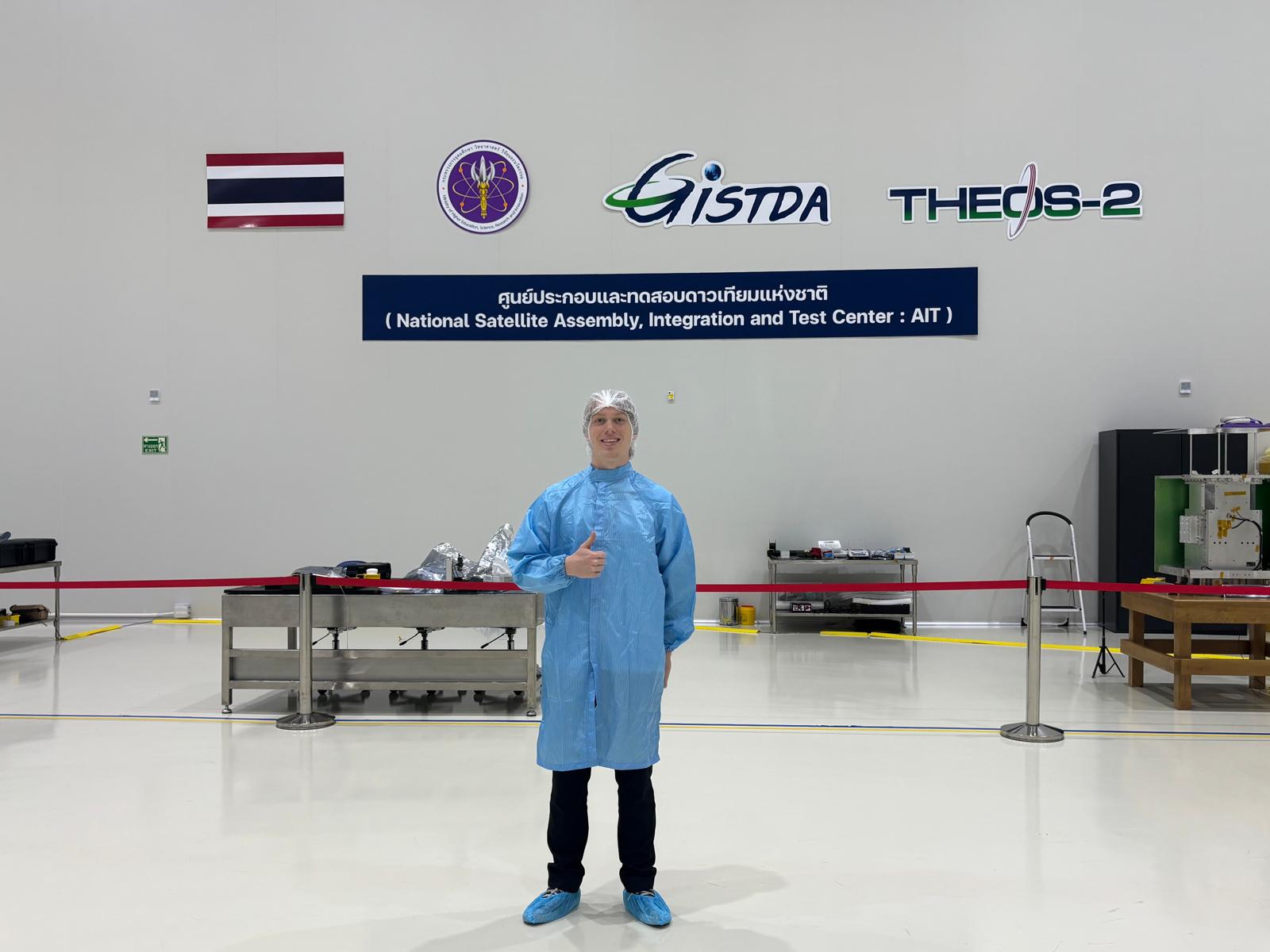
He was accepted as a flight dynamics intern.
Working on something real
In his role, Storm was responsible for predicting and managing satellite trajectories. Over time, satellites naturally lose altitude due to atmospheric drag and gravitational forces. His work involved calculating these changes and ensuring they remained in the correct orbit.
It’s complex, high-stakes work—far removed from what most people would expect from a recent graduate.
“It was a dream,” he says. “I got to go into the clean room, see the satellites up close… it was incredible.”
But when asked how he got there, his answer isn’t about technical knowledge alone.
“Don’t wait for someone to give you an opportunity,” he says. “If you see something you can do, just go for it.”
A different kind of preparation
Storm is quick to acknowledge that his path into university wasn’t identical to that of his peers.
In some academic areas, he felt less prepared. He hadn’t followed the same traditional curriculum. There were gaps in certain subjects.
At the same time, he entered with a completely different set of strengths.
He already knew how to build projects from scratch. He had experience working across different domains. He understood how to navigate unfamiliar challenges and teach himself what he needed to know.
Over time, those differences balanced out.
“In some areas, I was ahead. In others, I was behind,” he explains. “But in the end, everyone catches up.” He explains how being autonomous and knowing how to teach himself helped him fill in any gaps.
But the most marked difference—and perhaps the most important—wasn’t academic at all. It was maturity.
“I think I was more mature,” he says. “Especially emotionally.”
That didn’t happen by chance. At Learnlife, learning wasn’t limited to academic content. It included collaboration, self-awareness, and navigating challenges in real time. Over time, those experiences shaped how he worked with others, handled pressure, and approached complex situations—long before he entered university.
Building, experimenting, and adapting
Alongside his studies, Storm continued to build.
He worked with startups in Silicon Valley. Developed systems for mapping crime data across the United States. Collaborated with fire prevention teams in Catalonia, contributing to the detection of over 100 forest fires. And co-founded a company focused on scuba diving, with a model that funds coral restoration efforts.
It’s an impressive body of work by any standard (check out his LinkedIn bio here)—and even more so given how far it sits from the typical, linear path most learners take. Few learners build at this level, across this many domains, this early.
At times, it meant long days—balancing multiple projects, responsibilities, and ambitions at once.
“It’s amazing being able to do so many things,” he reflects. “But it’s also really hard to manage everything.”
What connects these experiences is not a single career path, but a mindset: one of exploration, iteration, and continuous learning.
Why this matters now
Storm’s story highlights something increasingly relevant in today’s world.
The pace of change is accelerating. Technology is evolving rapidly. Entire industries are shifting in ways that are difficult to predict.
In that context, static models of education struggle to keep up.
“The system was already behind,” Storm says. “Now it’s getting further behind every day.”
What becomes essential is not just knowledge, but adaptability. The ability to learn new things quickly, to navigate uncertainty, and to apply skills in unfamiliar contexts.
These are not skills easily developed through memorisation alone. They emerge through experience, experimentation, and ownership.
Not a place to finish—but a place to begin
When Storm reflects on his time at Learnlife, he doesn’t describe it as a stepping stone towards a diploma.
He describes it as something more foundational, as “A place where you can try things, fail, and try again,” he says. “Where you can explore everything.”
At Learnlife, Storm was able to move across music, coding, design, engineering, and storytelling—each offering a different way to engage with the world and make sense of it.
The aim of learning isn’t to specialise too early, but to discover what feels meaningful. And when something does resonate, to have the time and space to go deeper.
When the environment changes, everything else can too
Storm’s journey didn’t begin with success. It began with struggle.
With a system that didn’t recognise how he learned best. With assumptions about ability that didn’t reflect his potential. With an environment that, despite its intentions, couldn’t meet him where he was.
What changed wasn’t who he was.
It was the conditions around him.
And once those conditions shifted, his trajectory did too—from a student who was falling behind, to someone predicting satellite trajectories, building companies, and shaping his own path forward.
Written by